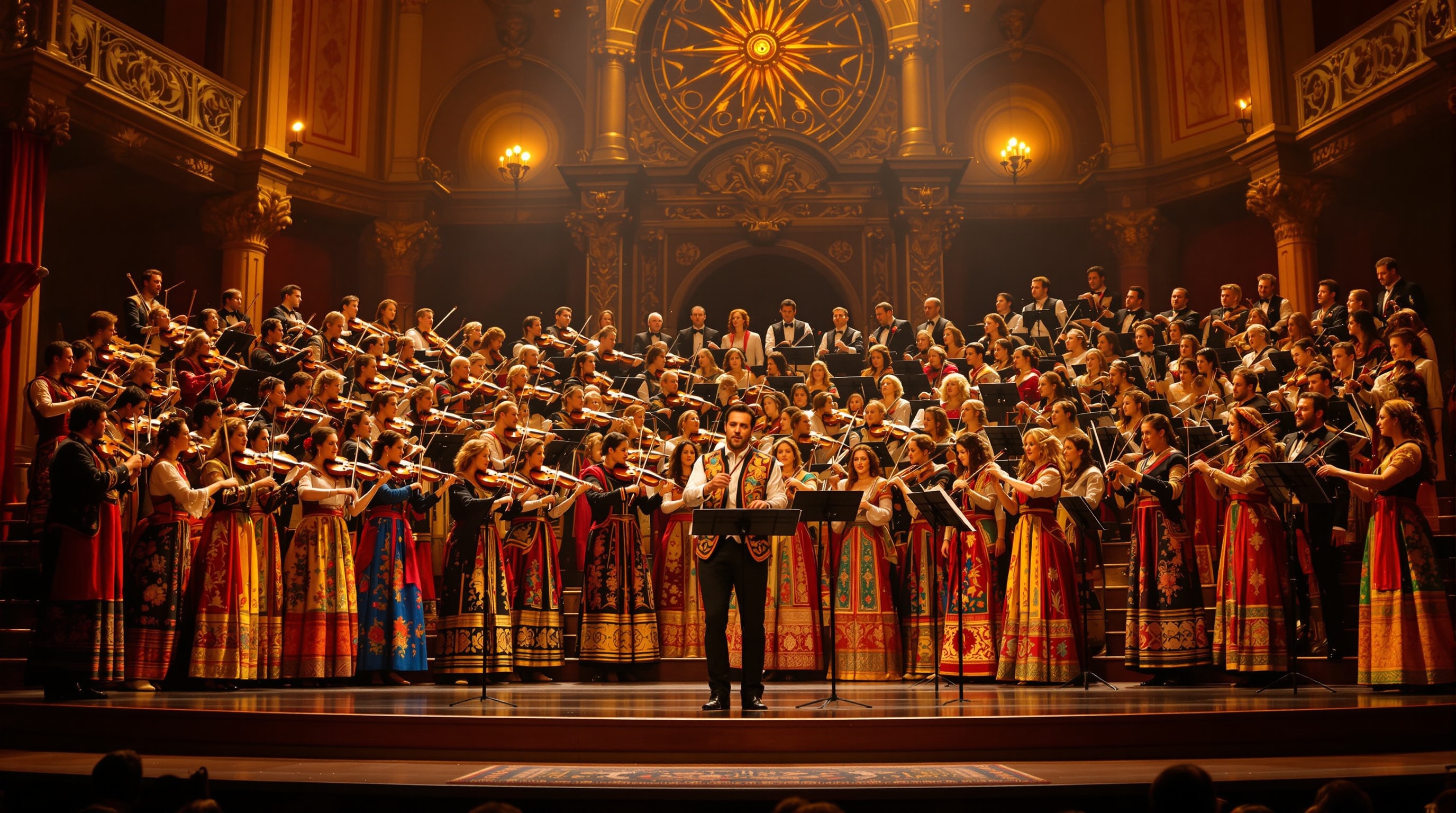
The Hundred-Violin Tradition
Ordinary symphony orchestras are assembled by audition and administered by institutions. A hundred-violin Gypsy orchestra is something else entirely: it is a gathering of musical families, and its story reads more like a legend than a founding document.
A Hundred, All at Once
They are a hundred. Violins in bright bouquets, but also violas, cellos, a rank of double basses, clarinets, and the hammered cimbalom — all united to carry an overwhelming tradition of feeling. That was how the ensemble described itself in its earliest materials, and the description still fits. The point of the hundred-violin orchestra is not merely size; it is the density of a single melodic line played by fifty violinists who have absorbed the same phrasing from childhood, so that the unison is total and the effect is enormous.
Where a classical orchestra prizes balance between sections, the Gypsy orchestra prizes the overwhelming power of the massed top line, coloured underneath by the shimmer of the cimbalom and the drive of the basses. It is a different aesthetic of the string ensemble altogether — one built for emotional immediacy rather than architectural balance.
Born at a Graveside
The best-known hundred-violin orchestra was founded in Budapest in 1985, and its origin story is genuinely moving. When one of Hungary's most celebrated Romani soloists — a "primás," or lead gypsy violinist — died, the country's gypsy musicians came together for the funeral. After the ceremony they began, spontaneously, to play. Out of that improvised moment of collective grief and homage, the idea of a permanent hundred-member orchestra was born: to gather, just once and then again and again, the impossible formation that had assembled on that single day of sorrow.
From a melancholy serenade at a graveside grew one of the largest touring string ensembles in the world. Within a few years the orchestra had drawn in Hungary's finest Romani players and begun to perform in the great concert halls and festivals of Europe.
The Musician Dynasties
What makes such an orchestra possible is a social fact as much as a musical one: the existence of extended Romani musician families in which the craft is transmitted from parent to child across many generations. Surnames from these dynasties recur again and again in the history of Hungarian gypsy music, and it was the reputation of those families that allowed a single orchestra to field a hundred players of the first rank.
Because the music is learned by ear and by apprenticeship rather than from notation, membership in the tradition is inseparable from family and community. This is why the orchestra can play an entire programme from memory: the repertoire is not read from a page but carried in the body, the product of a lifetime's immersion. To read more about the culture that sustains this, see our essay on Romani music heritage.
From Budapest to the World
Over the decades the tradition has travelled astonishingly far. Ensembles in this style have performed across Austria, Belgium, France, Germany, the Netherlands, Italy, Ireland, the Nordic and Baltic countries, Russia, Japan and beyond, thrilling audiences who had never encountered a hundred violinists playing as one. Honorary patrons of the tradition have included giants of the wider musical world, a sign of the respect the form commands well outside its home region.
That respect has since been formalised: the hundred-member Budapest orchestra is listed among Hungary's official "Hungarikum" national treasures, and in 2025 it marked forty years since its graveside founding. The tradition, in other words, is not a historical curiosity but a living art that continues to fill concert halls today.
A Heritage Worth Preserving
It is precisely because this music lives in people rather than in scores that it is fragile, and worth documenting. Institutions such as UNESCO's programme for intangible cultural heritage exist to safeguard exactly this kind of orally transmitted art. This project is a small, independent contribution to the same aim: to explain, celebrate and remember the hundred-violin tradition for readers who may never have the words to describe what they felt when they first heard it. Continue with the instruments of the orchestra.