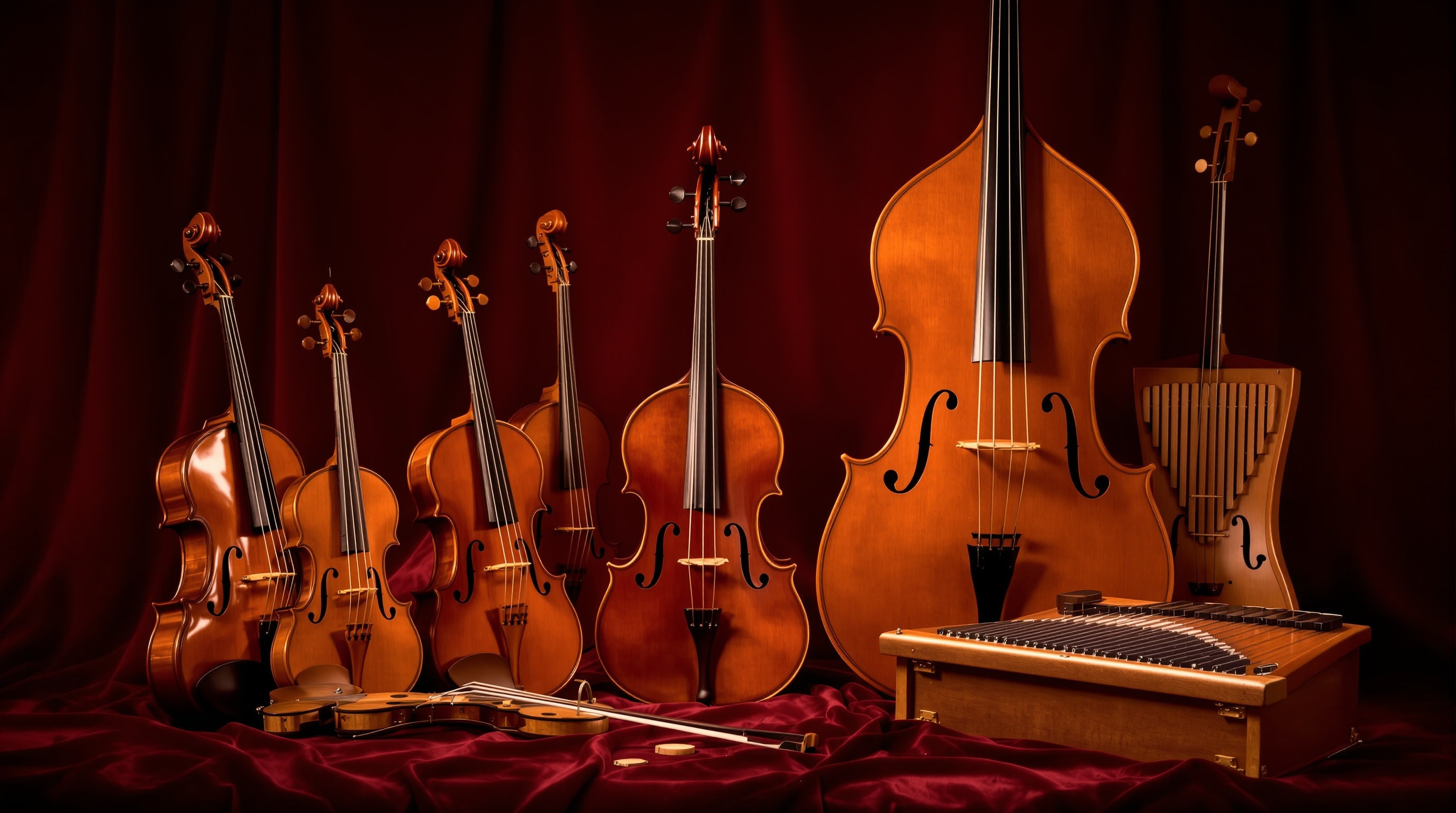
Instruments of the Gypsy Symphony Orchestra
A hundred-violin orchestra is not simply a hundred violins. Its unmistakable sound comes from a carefully weighted blend of strings, a single reed voice, and the percussion-strings of the cimbalom — a combination unlike any standard symphonic layout.
The Weight of the Strings
In the classic hundred-piece formation the strings dominate overwhelmingly. A characteristic breakdown places roughly fifty violins at the top, supported by around ten violas, ten cellos and eleven double basses. That is a top-heavy design by orchestral standards, and deliberately so: the massed violins carry the melody in a single enormous line while the lower strings supply drive and depth rather than independent counterpoint.
The effect is a wall of unison melody with tremendous forward momentum. Because so many players share the tune, small variations in vibrato and bow-speed thicken the sound into something almost choral. The double basses, unusually numerous, give the ensemble the propulsive pulse that makes its dance music irresistible.
The Reed and the Cimbalom
Threaded through the strings are a handful of clarinets — often nine or so in the full formation — whose bright, agile voice can leap above the violins in fast passages and add a rustic, folk-band colour. The clarinet is the orchestra's link to the village wedding band, and its role is soloistic and ornamental as much as harmonic.
At the centre of everything sits the cimbalom, the large Hungarian hammered dulcimer. Usually six of them anchor the full orchestra. The cimbalom is the instrument that most defines the ensemble's identity: its shimmering tremolo and rapid arpeggios fill the harmonic space between the singing violins and the driving basses, and its players are among the most virtuosic musicians on the stage.
Playing Without a Score
Perhaps the most astonishing fact about the ensemble is that it plays entirely from memory. There are no music stands, no printed parts, no conductor beating time. An entire evening's programme — dances, rhapsodies, classical arrangements — is held in the collective memory of the players and coordinated by the lead violinist, or primás, through gesture and musical cue.
This is only possible because the musicians share a common tradition learned by ear from childhood. It also transforms the visual experience of a concert: with no scores to bury their faces in, the players watch one another and the audience, and the performance becomes intensely physical and communicative.
How the Sections Balance
The genius of the arrangement lies in how these forces are balanced. The massed violins own the melody, but they would tire the ear if they never rested; so the arranger passes the tune to a solo violin or a leaping clarinet, lets the cimbaloms take a shimmering interlude, or drops to the growl of the basses alone before the full ensemble returns in a wave. Density is a compositional tool, and a great Gypsy-orchestra arrangement is a study in when to overwhelm and when to whisper.
This is also why the ensemble can play music of such different characters — a tender lament, a whirling dance, a grand classical rhapsody — with the same forces. The instrumentation is fixed, but the way the sections combine is endlessly flexible, and it is in that flexibility that the artistry lives.
Costume, Colour and Spectacle
The orchestra performs in colourful traditional dress, and the visual impact is part of the art. A hundred musicians in richly coloured costume, far more numerous than most classical orchestras, create a spectacle before a note is played. Museums such as the Metropolitan Museum of Art's department of musical instruments preserve historic examples of many of these instruments, a reminder that the violin, cello and cimbalom each carry centuries of craft.
Every element — the top-heavy strings, the leaping clarinets, the anchoring cimbaloms, the memorised repertoire and the costume — combines into a single overwhelming effect. To understand the music those instruments play, continue to the repertoire and the csárdás.