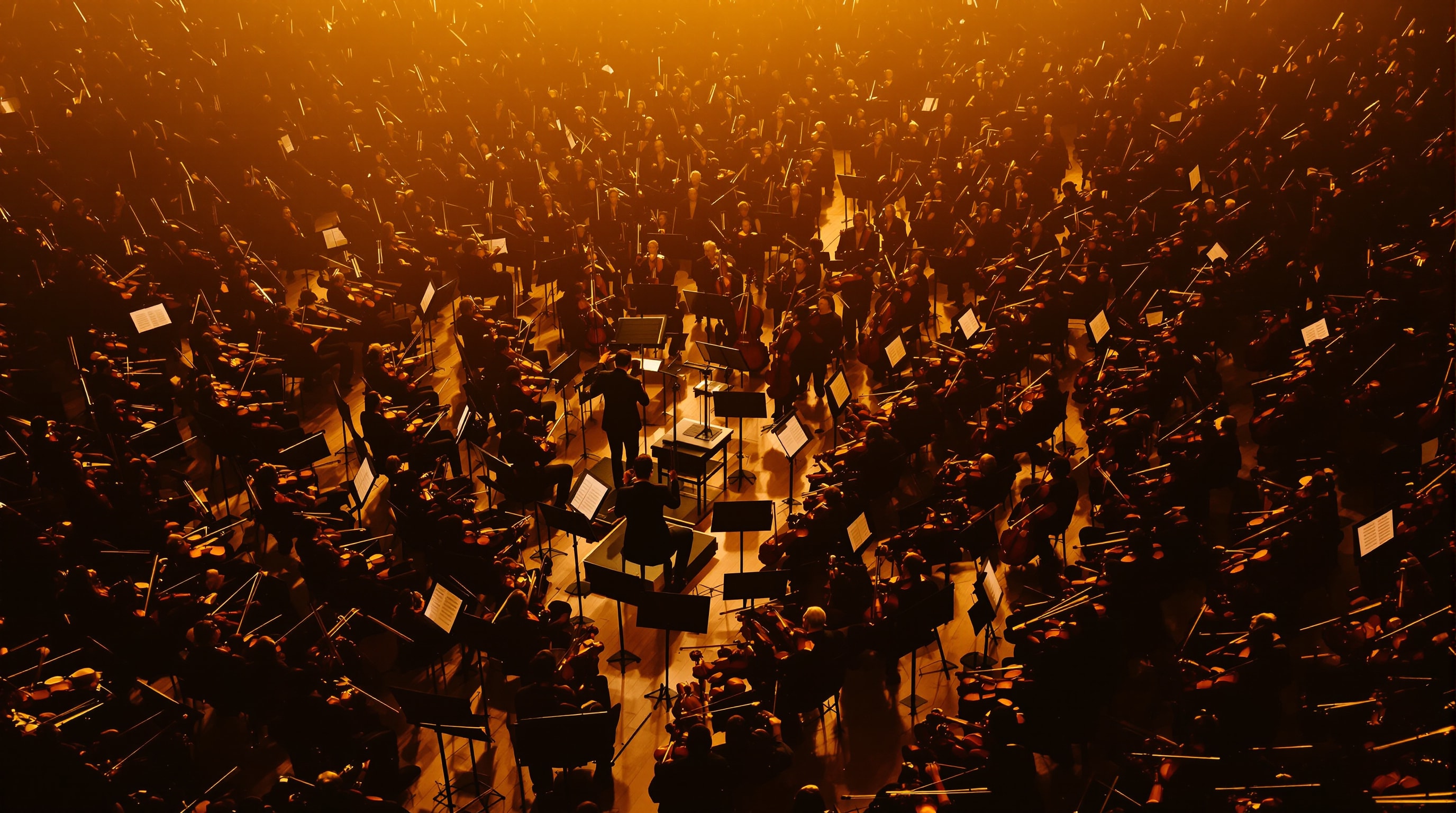
Massed Strings in Concert
There is a particular kind of goosebump that only a large body of strings can raise. A hundred violins playing a single melody together is not just louder than one violin; it is different in kind — warmer, wider, and strangely more human. Understanding why reveals something about music itself.
The Physics of the Blend
When many string players sound the same note, their pitches and vibratos are never perfectly identical. Those tiny differences — a few cents of pitch here, a slightly different vibrato speed there — cause the sound waves to beat gently against one another, producing the rich, shimmering "chorus" effect that a single instrument cannot. The more players, the deeper the blend.
This is why a massed violin line feels enveloping rather than pointed. The ear cannot pick out any single player, so it hears instead a single vast instrument with enormous warmth and presence. In a hundred-piece Gypsy orchestra this effect is pushed to its limit, and the result can be overwhelming in the most literal sense.
Unison as Emotional Power
Classical orchestration usually divides the strings into independent parts — first and second violins, violas, cellos — to build harmony and counterpoint. The Gypsy orchestra often does the opposite, throwing the full weight of the violins onto a single melodic line. That massed unison carries a raw emotional force: everyone is singing the same song, and the listener feels the unanimity in the body.
It is the same instinct that makes a stadium crowd singing one tune so moving. Unison is a statement of shared feeling, and a hundred musicians committing to one line is about as powerful a statement as instrumental music can make.
A Long Fascination
The dream of massed strings is old and recurring. Baroque courts staged grand concerts with unusually large string bands; the nineteenth century loved monster concerts with hundreds of players; and the modern string orchestra, film score and light-orchestral tradition all trade on the lushness of many strings together. Museums and archives of performance history, including collections at the Library of Congress, document how audiences have always been drawn to the spectacle of the very large ensemble.
The Gypsy symphony orchestra is a distinctive branch of this family tree. It brings to the massed-string ideal something the concert tradition often lacks: the freedom, ornament and improvisatory fire of an oral folk art, so that the sheer size serves feeling rather than formality.
Size, Intonation and the Human Touch
There is a paradox at the heart of massed strings: the effect depends on imperfection. If a hundred violins could be tuned to mathematically identical pitches and play with machine precision, the sound would be cold and thin, like a synthesizer. It is the tiny, unavoidable human variations — the slight differences in tuning, timing and vibrato — that give the massed line its warmth and depth. The blend is, quite literally, the sound of many human beings rather than one machine.
This is worth remembering in an age of digital music, where perfection is cheap and ubiquitous. The massed Gypsy orchestra offers the opposite: a hundred fallible, expressive musicians whose very humanity is the point. The warmth you feel is the sound of imperfection made beautiful, and no algorithm can fake it.
The Case for Hearing It Live
No recording fully captures massed strings. Microphones and loudspeakers collapse the three-dimensional wash of sound into something flatter and smaller, and they cannot reproduce the physical sensation of air moved by a hundred instruments. This is one tradition you genuinely have to experience in person.
If you have the chance to hear a large Gypsy orchestra or any massed-string ensemble live, take it — and bring what you have learned here. Our listening guide will help you hear more in the moment, and the violin's double life explains how folk and classical worlds meet on that stage.