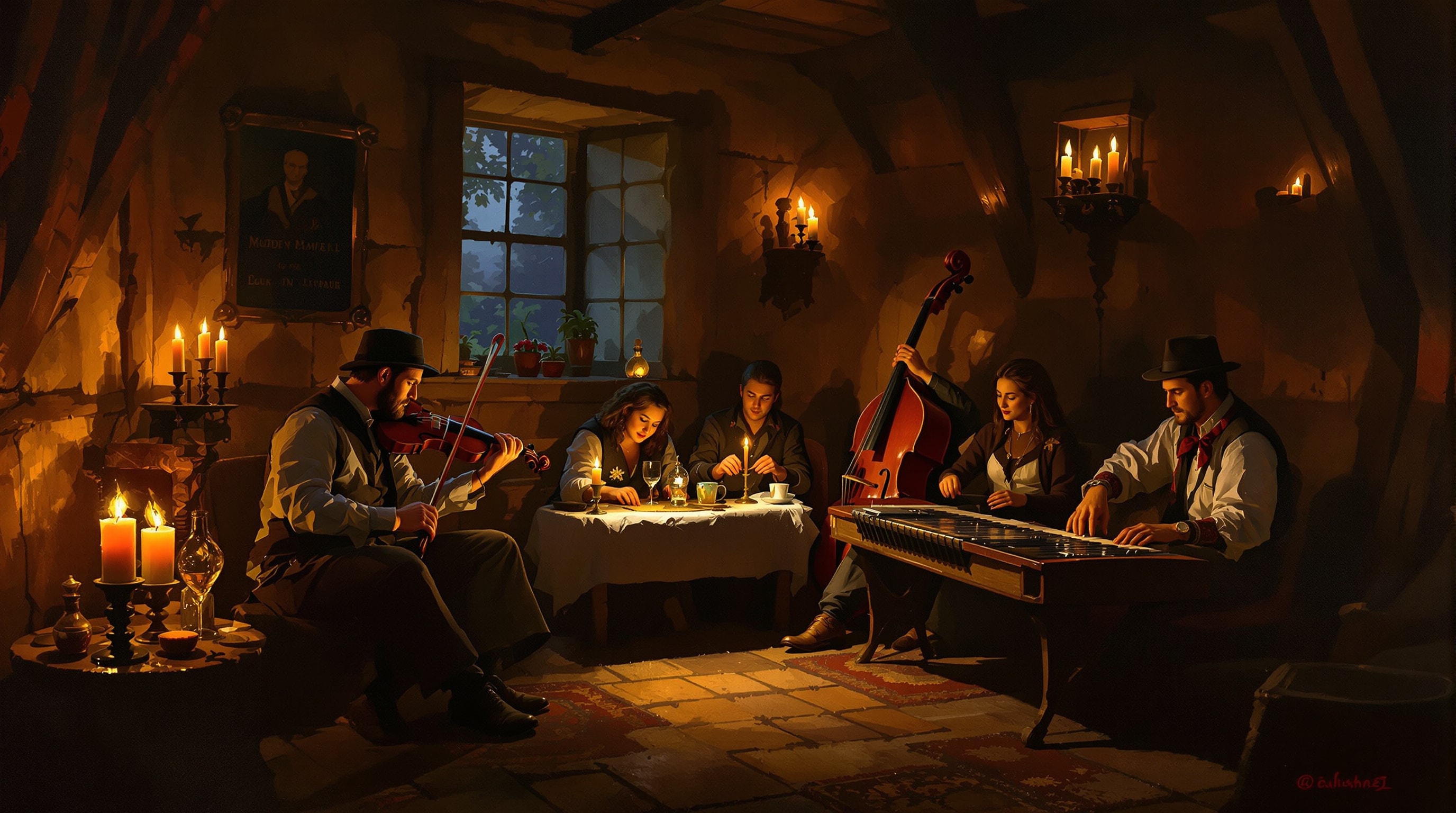
Romani Music Heritage
Behind the spectacle of a hundred violins lies a people, a history and a way of transmitting art that is unlike anything in the conservatoire. To understand the Gypsy orchestra, you have to understand the Romani musical culture that created it.
A People and Their Music
The Roma — historically called Gypsies, a term now often avoided but preserved in some traditional ensemble names — are an ethnic group whose ancestors migrated from the Indian subcontinent to Europe over many centuries. Encyclopaedic overviews such as Encyclopaedia Britannica's account of the Roma describe a diaspora that spread across the continent, carrying and absorbing musical influences at every stop.
In Central and Eastern Europe, and especially in Hungary, Romani musicians became the professional interpreters of the region's popular and art music. For generations they were the musicians of the wedding, the café, the restaurant and the concert stage — a role that made them custodians and transformers of a shared musical language.
The Family Dynasties
The engine of this tradition is the extended musical family. In the great Hungarian-Romani dynasties, children are surrounded by professional music from birth and begin to absorb the instruments and the repertoire long before formal lessons could begin. Craft, reputation and livelihood pass down the generations together.
This is why a single orchestra can assemble a hundred first-rate players who already share a common phrasing: they are drawn from families that have, in effect, been rehearsing together for a century. The dynasty system is the social technology that makes the massed unison of the hundred-violin orchestra possible.
An Oral Tradition
Perhaps the most important thing to grasp is that this is fundamentally an oral art. The music is learned by ear, by imitation and by apprenticeship, not from notation. A young player learns by sitting beside an elder, watching the hands, catching the ornaments, and gradually taking on the responsibility of the line.
Oral transmission gives the music its freshness and its danger — every performance is partly improvised — but it also makes the tradition fragile. When a lineage is broken, knowledge is lost that no score can recover. Organisations devoted to intangible cultural heritage exist precisely to help such living traditions survive.
The Café as Conservatory
For much of the nineteenth and twentieth centuries, the café and restaurant were to Romani musicians what the conservatory was to their classical counterparts: the place where standards were set, reputations made, and repertoire exchanged. A leading café ensemble played long hours, night after night, for audiences who knew the music intimately and expected both faithful favourites and dazzling invention.
That environment bred a particular kind of musician — versatile, quick, able to read a room and shape a melody to the mood of the moment. When such players were gathered into a large concert orchestra, they brought with them this hard-won fluency, which is why even the biggest Gypsy ensembles retain the intimacy and spontaneity of the café band scaled up a hundredfold.
Influence Far Beyond the Community
Romani music has shaped European culture out of all proportion to the size of the community. Its scales, ornaments and rhythmic freedom fed directly into the nineteenth-century classical imagination — into Liszt, Brahms and countless others — and its café style became, for much of the world, the very sound of Hungary. Recordings held by archives such as Smithsonian Folkways document the breadth of Romani musical traditions across many countries.
To hear how this heritage is voiced through a single leader, read about the primás tradition; to hear it in the repertoire, see the csárdás and the classical crossover.